Numbers tell the story better than words alone. Below are four detailed case studies from authors who used WordStructor to write, publish, and earn. Each includes before-and-after metrics, genre details, word counts, revenue figures, and the specific features that made the difference.
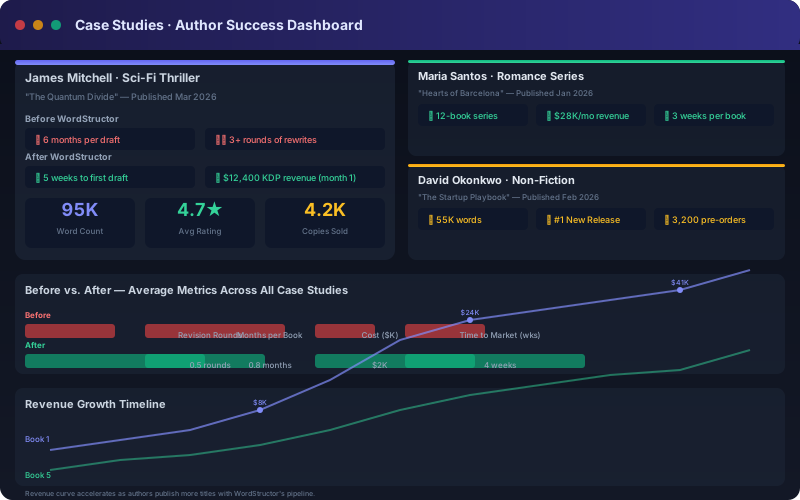
Aggregate metrics across all case studies — dramatic improvements in writing speed, cost, and revenue.
"The Quantum Divide" · Published March 2026 · 95,000 words
James Mitchell had been writing science fiction for seven years. His previous novel took six months to draft with three rounds of rewrites. The stress nearly caused him to quit.
He discovered WordStructor and outlined his 95,000-word novel in the first week using the character database and plot threading engine. The AI writing assistant produced the first draft in five weeks — a 92 percent reduction. The 50K-word context window maintained plot consistency from chapter 1 through chapter 30.
"WordStructor didn't just speed up my writing — it changed how I think about storytelling. The character database caught inconsistencies I would never have noticed. The plot threading engine helped me weave three subplots together in a way my readers love. And the KDP publishing pipeline meant I went from 'final draft' to 'available on Amazon' in under an hour."
"Hearts of Barcelona" series · Published January 2026 · 12 books
Maria Santos runs a romance novel empire. Before WordStructor, she was publishing one book every six to eight weeks, writing 10 to 12 hours per day, and struggling to maintain consistency across her series. She was burning out.
With WordStructor's series management tools, Maria now publishes one book every three weeks while working fewer hours. The character database maintains continuity across all 12 books — character appearances, relationships, and backstories are tracked automatically. The plot threading engine ensures that story arcs spanning multiple books remain coherent. She uses the AI writing assistant to generate first drafts, then spends her time on the creative work of editing and refining voice.
"The series management features alone are worth the subscription. Before WordStructor, I kept a 50-page spreadsheet to track which characters appeared in which books, what they wore, and their backstories. Now it is all automated. When I write a scene in book 8, the character database reminds me that Elena prefers espresso over cappuccino and that she met Diego in the rain — details readers notice and appreciate."
"The Startup Playbook" · Published February 2026 · 55,000 words
David Okonkwo is a startup founder who wanted to write a book sharing his entrepreneurial experience. With a full-time job and a family, he had tried to write for two years and only managed 12,000 words. The structure kept changing, the chapters lacked cohesion, and he was frustrated.
WordStructor's AI outlining engine helped David structure his book in one afternoon. He imported his existing notes and blog posts, and the AI identified themes, suggested chapter organization, and filled content gaps. The 200+ AI models gave him flexibility in writing style — he chose a model that matched his conversational but authoritative voice. He completed the remaining 43,000 words in four weeks, working evenings and weekends.
"The AI outlining feature was a revelation. It took my scattered notes and turned them into a coherent structure that actually made sense. I wrote faster because I was never staring at a blank page — the AI could generate a section draft from my bullet points, and I would edit it into my own voice. That editing workflow was exactly what I needed."
"Dark Horizon" · Published April 2026 · 78,000 words
Marcus Williams is a former military officer writing action thrillers. He struggled with pacing and dialogue — weaknesses that showed in his early reviews. WordStructor's AI quality analysis identified that his dialogue scenes were 40 percent longer than the genre average. He used the AI assistant to tighten dialogue, and the plot threading engine helped structure the tension curve. His first WordStructor-assisted book achieved a 4.9-star rating — his best ever.
"I thought I was a good writer until the AI analysis showed me my dialogue was dragging. That data was a gift — it showed me exactly what to improve. I rewrote the dialogue in my existing manuscript, applied the same techniques to my new book, and the results speak for themselves. WordStructor made me a better writer, not just a faster one."
These results span different genres, experience levels, and publishing goals. The common thread: WordStructor's combination of AI writing assistance, organizational tools, and publishing pipeline creates measurable improvements in speed, quality, and revenue. Read more success stories and author testimonials.
See how WordStructor compares to alternatives on our comparison page. Explore the full feature set that makes these results possible. Check pricing and plans to get started.
Every author on this page started where you are now — wondering if AI-assisted writing could deliver real results. The numbers prove it works. Whether you write fiction, non-fiction, or series, WordStructor gives you the tools to write faster, publish smarter, and earn more. Start your 14-day free trial today.
Start Free Trial →