White-label SaaS is one of the fastest-growing models in the writing software industry. This guide explains what white-label book writing software is, how to resell WordStructor under your own brand, pricing models that work, the technology stack powering your instance, and how to build a sustainable reseller business around AI-assisted authorship.
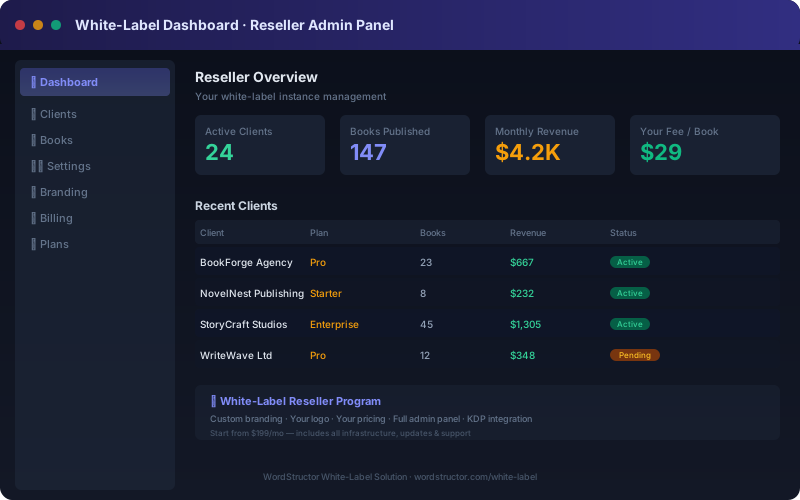
The white-label reseller dashboard — manage clients, track books, monitor revenue, all under your own brand and domain.
White-label software is a fully functional product developed by one company that another company rebrands and sells as its own. In the context of book writing, white-label software means you take the complete WordStructor platform — desktop app, AI engine, character database, plot threading, KDP export, and plugin infrastructure — and put your own logo, brand name, domain, and pricing on it. Your customers never know they are using a platform built by WordStructor. They see your brand, pay you, and you manage their accounts through a dedicated admin panel.
This model has exploded in popularity because it eliminates the need to build complex AI infrastructure from scratch. Instead of hiring engineers, training models, and maintaining servers, you focus on marketing, customer acquisition, and brand building while WordStructor handles the technology, updates, and scaling.
When you sign up for the WordStructor white-label program, you receive a dedicated instance of the platform configured under your brand. Here is the step-by-step workflow:
We offer three white-label pricing tiers designed to scale with your business. Each tier includes the full WordStructor feature set — AI models, character database, plot threading, plugin store, and KDP export — with different limits on active users and administrative features.
Most resellers start with the Starter plan, validate their market, then upgrade to Pro as they acquire customers. The break-even point is typically 10 to 15 customers, after which your margin is pure profit.
Your white-label WordStructor instance runs on the same battle-tested infrastructure that powers the main platform. You do not need to manage servers, databases, or AI model deployments — but here is what powers your branded experience:
24MB installer built on Electron with native Windows optimizations. Automatic updates, offline mode, and full character database support.
200+ models routed through intelligent load balancing. Supports OpenAI, Anthropic, Google, Mistral, Ollama local models, and custom endpoints.
Web-based admin panel with real-time usage metrics, user management, billing integration, and white-label configuration settings.
Horizontally scalable backend on AWS/GCP with per-tenant isolation, encrypted storage, and 99.9% uptime SLA for Enterprise plans.
The most successful white-label resellers in the book writing space follow one of several proven go-to-market strategies. Some target niche genres: a reseller focused on Christian fiction may brand WordStructor as a dedicated Christian novel writing tool, complete with genre-specific templates and community. Others target geographic markets: a reseller in Brazil can offer a Portuguese-branded writing platform at local pricing with local payment methods. Still others bundle the software into coaching or ghostwriting services, providing the tool as a value-add for their existing clients.
Regardless of your approach, the key metrics to track are customer acquisition cost (CAC), lifetime value (LTV), and monthly active users. WordStructor's white-label dashboard surfaces all three. For a deeper look at running multiple brands simultaneously, see our multi-brand strategy guide.
Do my customers see the WordStructor name anywhere? No. The desktop app, login page, domain, and all communications are branded to your company. The WordStructor name appears only in your admin panel and legal agreements.
Can I migrate my existing users to a white-label instance? Yes. We provide import tools for common formats and can assist with custom migrations for Enterprise customers.
What happens if I cancel my white-label subscription? Your users retain access to their data for 30 days, giving you time to export or transition them. Enterprise plans include extended migration windows.
Is there a minimum commitment? Starter and Pro plans are month-to-month with no annual commitment required. Enterprise plans typically require a 12-month agreement.
For more detailed technical documentation, visit our documentation page. To see how agencies use white-label WordStructor with team accounts and pipelines, check out agency writing tools.